For years, the conversation around dealership advertising has focused on media buying.
Which channels deserve more budget? Where should you target shoppers? How do you improve cost per lead?
Those questions still matter. But they no longer represent the biggest challenge facing dealership marketing.
Creative does.
Not because dealerships have run out of good ideas or agencies have forgotten how to build compelling campaigns. The challenge is much more practical than that.
Modern dealership marketing demands more creative than ever before. Every campaign now has to work across multiple channels, audiences, formats, and stages of the buying journey. What was once a handful of assets has become hundreds.
That’s fundamentally changing the role creative plays in dealership advertising.
It’s no longer just about producing great work. It’s about producing enough great work to keep pace with how consumers shop today.
Creative Has Become an Operational Problem
Not long ago, a dealership could launch a monthly campaign with a television commercial, a handful of display ads, some paid search, and a few social posts. That was enough to maintain visibility and generate traffic.
Today’s buyer journey looks very different. Shoppers discover vehicles on social media, compare models on YouTube, search Google multiple times, visit dealership websites, and often return days or weeks later after encountering another ad somewhere else.
Google’s research on the “Messy Middle” shows that shoppers move repeatedly between exploration and evaluation before making a purchase.
As we’ve explored in previous articles, today’s path to purchase is anything but linear. The challenge is that creative now has to keep up with that journey.
That means your creative can’t be linear either.
A single message simply isn’t enough anymore. Different audiences require different messaging. Different channels require different formats. Inventory changes. Incentives change. Consumer interests change.
The amount of creative required to support a modern dealership has expanded dramatically.
The challenge isn’t having better ideas. It’s keeping up.
One Campaign Isn’t One Campaign Anymore
Launching a campaign used to be relatively straightforward. A dealership would create a television commercial, a few display ads, some paid search copy, and maybe a handful of social posts.
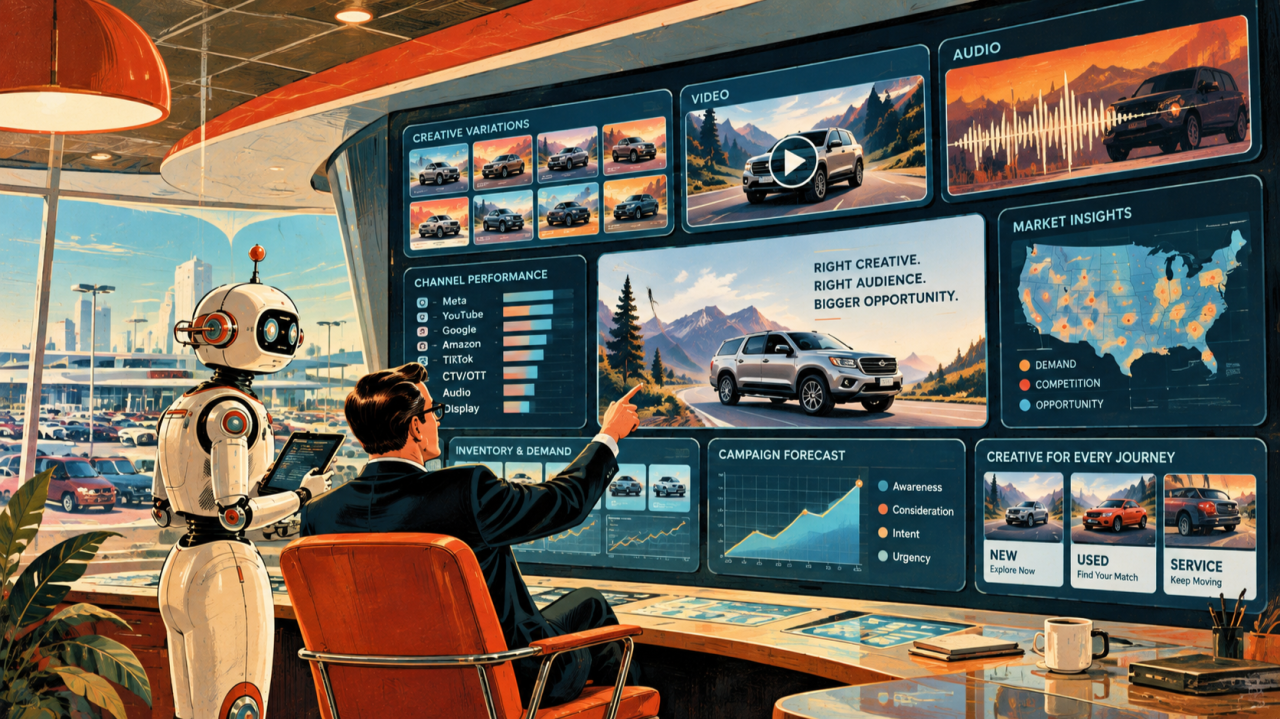
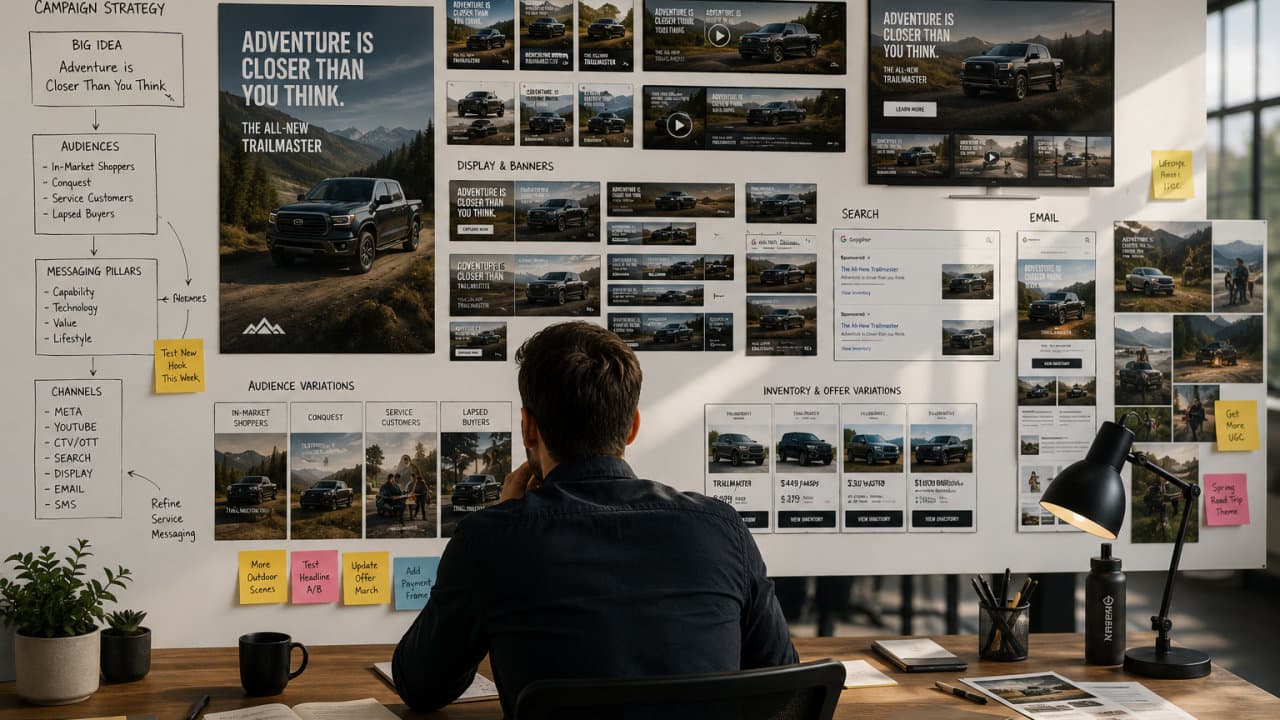
Today, that same campaign has to work across Meta, YouTube, Connected TV, search, display, and an ever-growing list of digital channels. It has to support multiple audiences, adapt to different formats and screen sizes, reflect current inventory and incentives, and evolve as performance data comes in.
Now multiply that by every model on the lot, every monthly offer, every seasonal event, and every profit center.
One campaign no longer produces a handful of assets. It can easily produce hundreds.
That’s before you test new messaging, refresh fatigued creative, localize campaigns for different markets, or respond to changes in inventory.
The problem isn’t that creative teams lack talent or ideas. The problem is that the workload has outgrown the traditional creative process.
More Creative Isn’t Enough. It Has to Be Relevant.
Consumers don’t just expect more content. They expect content that feels relevant.
According to McKinsey research, 71% of consumers expect companies to deliver personalized interactions, while 76% become frustrated when those expectations aren’t met. That expectation has fundamentally changed what dealership creative needs to accomplish.
That’s a challenge for every dealership.
The same generic creative can’t effectively speak to someone shopping for a heavy-duty truck, a first-time EV buyer, and a service customer due for maintenance. Even shoppers considering the same vehicle may respond to different messages depending on where they are in the buying process.
Relevance has become just as important as reach. The challenge is producing that level of relevance consistently without slowing everything else down.
This Is Where AI Changes the Conversation
The opportunity isn’t replacing creative. It’s removing the production constraints that have limited it for years.
Instead of asking creative teams to produce more with the same time and resources, AI makes it possible to execute at a scale traditional workflows simply can’t match. Campaigns can adapt to different audiences, channels, formats, and changing inventory without creating bottlenecks for the people responsible for strategy.
That’s the real shift. The question is no longer, Can we produce enough creative? It’s, What’s the best creative to produce?
The Next Competitive Advantage
The dealerships that outperform the market over the next decade won’t necessarily have the biggest budgets or the largest creative teams.
They’ll rethink how creative gets done.
Instead of asking people to produce more, they’ll use AI to handle the repetitive work, freeing their teams to focus on strategy, storytelling, and smarter marketing decisions. That’s what it means to be AI-native.
The future won’t be won by creating one great advertisement. It will be won by building a creative system capable of delivering the right message, to the right shopper, at the right time, at the scale modern marketing demands. Because AI isn’t replacing great creative. It’s finally making it possible.
The question for dealership leaders isn’t whether AI will change marketing.
It’s whether their marketing operation is ready for it.