For years, dealership advertising was built around interruption.
Buy television. Reach as many people as possible. Hope the message lands at the right time.
Then digital changed everything. Search became the center of the strategy. Social exploded. Attribution dashboards took over the conversation. The industry shifted toward lower-funnel metrics because they were measurable, immediate, and easy to defend.
But somewhere along the way, dealerships stopped thinking enough about reach in modern automotive advertising.
That matters because market share growth rarely starts at the bottom of the funnel. It starts much earlier, before someone searches, before they submit a lead, and often before they even know exactly what they want to buy.
That is where Connected TV advertising has become one of the most important channels in modern dealership advertising strategies.
The Consumer Shift Already Happened
The conversation around streaming often sounds futuristic, but the reality is that the shift already occurred.
In 2025, streaming officially surpassed broadcast and cable television combined for the first time ever according to Nielsen. Streaming accounted for 44.8% of all television viewing while broadcast and cable combined represented 44.2%.
That is a massive shift in consumer behavior.
Consumers are now spending more time on platforms like YouTube, Hulu, Roku, Netflix, and Amazon Prime Video than traditional linear television. According to industry reporting, Connected TV penetration in the U.S. has now reached roughly 90% of households, while Roku alone recently surpassed 100 million streaming households globally.
This is no longer an emerging channel. It is mainstream consumer behavior.
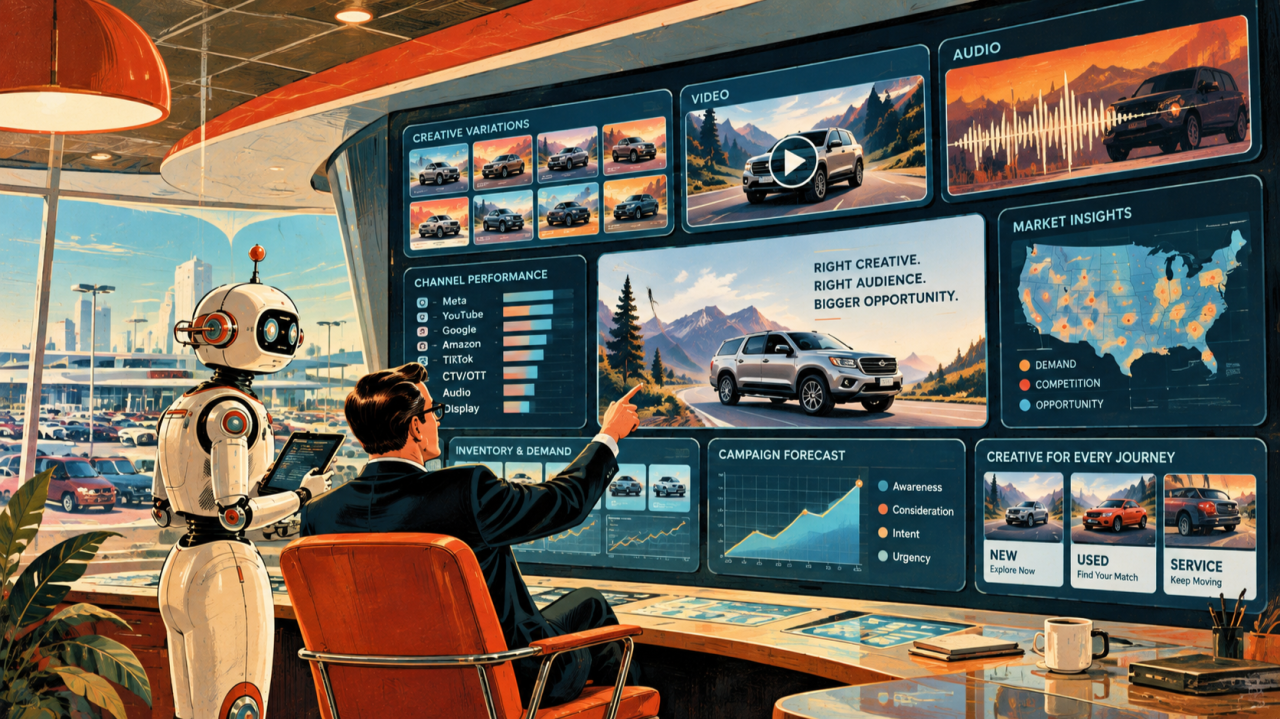
And unlike traditional television, Connected TV allows dealerships to target households based on geography, shopping behavior, ownership data, demographics, and intent signals. Dealers are no longer buying generalized exposure across an entire DMA. They are buying precision reach at scale.
That changes the role of video advertising completely.
CTV Is Not Traditional Television with Better Reporting
One of the biggest mistakes in automotive advertising is treating Connected TV like digital cable.
Traditional television was built around broad audience assumptions. Connected TV is built around audience identification.
A dealership can now serve video creative to households based on ZIP code, vehicle ownership, lifestyle indicators, or even prior digital engagement patterns. Instead of hoping the right shopper sees the message, dealers can focus investment toward the audiences most likely to influence future sales and service demand.
That matters because competition at the bottom of the funnel has become incredibly aggressive.
Search costs continue rising. Social platforms are crowded. Most dealerships are competing for the same in-market shopper at the exact same moment. CTV creates a way to influence buyers before that bidding war even starts.
Incremental Reach Is the Real Value
Most dealerships still evaluate advertising primarily through a conversion lens. That creates blind spots.
Not every channel exists to close demand immediately. Some channels exist to expand demand.
That is where Connected TV becomes incredibly valuable.
Consumers no longer move through a perfectly linear funnel. They bounce between streaming content, social feeds, YouTube research, search activity, review sites, OEM pages, and dealership inventory pages constantly. CTV allows dealerships to insert themselves earlier into that process while reaching audiences that search and social are not reaching efficiently on their own.
That incremental reach is critical for market share growth.
A dealership cannot grow market share by repeatedly talking only to shoppers already deep in the funnel. Eventually, that becomes a race to higher costs and diminishing returns. Growth happens when dealerships expand the number of consumers engaging with the brand in the first place.
According to Samsung Ads:
Nearly half of all CTV viewers are considered “cord-cutters” or “cord-nevers,” meaning they are either spending little time with traditional cable television or avoiding it entirely.
That is why CTV matters.
It expands reach beyond the lower funnel while influencing shoppers before they ever submit a lead or search inventory.
Video Influence Matters More Than Last Click
One of the challenges with CTV is that dealerships often try to measure it like a lead-generation channel.
It is not – CTV is an influence channel.
The shopper who converts through branded search may have already seen dealership creative across streaming environments for weeks beforehand. The customer who walks into the showroom may have interacted with video messaging across multiple devices long before submitting a lead.
But most attribution systems still over-credit the final interaction before conversion while under-crediting the channels that created familiarity and intent earlier in the process.
Consumers do not behave according to attribution models. They behave according to influence.
And video remains one of the strongest influence mechanisms in advertising.
The Bigger Opportunity
The future of dealership advertising is probably not one platform.
It is the ability to orchestrate channels together intelligently.
But Connected TV is becoming increasingly difficult to ignore because consumer attention has already moved there. Streaming is where consumers spend time, where households consume content, and increasingly where dealerships can expand reach, influence buyers earlier, and reduce dependence on expensive lower-funnel competition.
That does not mean every dealership should abandon traditional channels overnight.
But it does mean the dealerships still treating Connected TV like an optional experiment are probably behind where consumer behavior already is.