
Justin Friend click to view the linkedin profile of : Justin Friend
Most dealerships think digital marketing is about capturing demand.
Someone searches. They click. They convert.
That’s the playbook.
And it works, to a point.
But if that’s all you’re doing, you’re not growing market share. You’re competing for it.
There’s a difference.
Capturing Demand Is Not the Same as Creating It
Capturing demand is reactive by nature. It shows up when a shopper is already in market, already researching, already narrowing their options. Search, retargeting, inventory-driven ads all sit here. They’re designed to intercept a decision that is already forming.
That’s important. It should be part of every strategy.
But it has a hard ceiling.
There are only so many in-market shoppers at any given time. You’re not increasing that number. You’re just trying to win a larger share of it. And so is every other dealer in your market.
That’s why performance starts to feel volatile. Costs creep up. Lead quality softens. Results flatten out.
You’re fishing in the same pond. Just with more lines in the water.
Creating demand changes the equation.
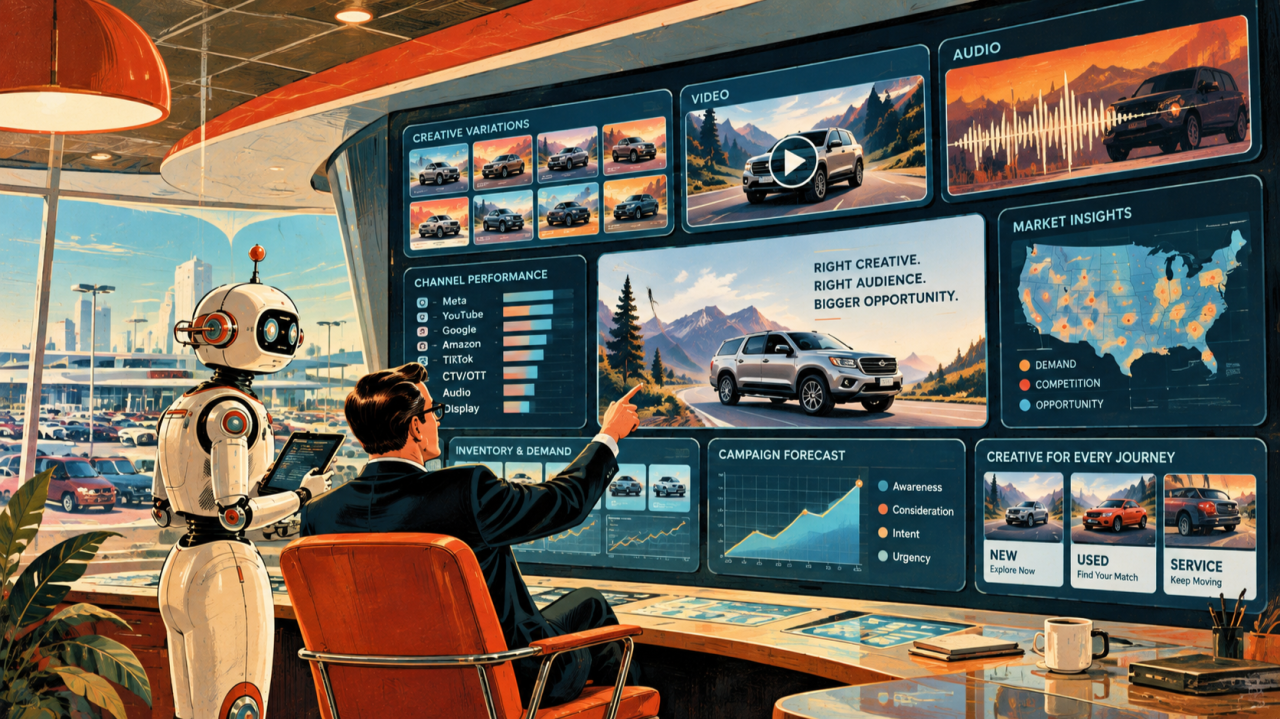
It’s not about waiting for someone to raise their hand. It’s about influencing them before they ever get there. Before they search. Before they compare. Before they decide where they’re going to buy.
That’s where market share actually shifts.
The Ceiling Most Dealers Run Into
If your strategy is built entirely around the bottom of the funnel, you will hit a wall. Period.
It doesn’t matter how much you spend or how well your campaigns are optimized.
At some point, you’ve exhausted the available demand.
From there, the only way to grow is to pay more for worse outcomes or to squeeze incremental gains out of a shrinking pool of high-intent buyers. Neither is sustainable.
This is where a lot of dealers get frustrated. The assumption is something is broken. In reality, the strategy just isn’t built to grow beyond a fixed opportunity.
Market Share Is Won Earlier Than Most Think
Here is the key: By the time a shopper searches, a meaningful portion of the decision has already been made.
They’ve seen certain brands more often. They’ve started to recognize names. They’ve developed a level of comfort, even if they can’t explain why.
That exposure doesn’t happen in search.
It happens while they’re watching content, scrolling social, listening to audio, or streaming at night. Moments where they’re not actively shopping, but they’re forming preferences.
If your dealership isn’t present in those moments, you’re not shaping demand. You’re stepping in at the end and hoping you can win it.
Sometimes you will. Most of the time, you’re late.
Upper Funnel Is Not a Branding Exercise
This is where the conversation usually goes off track.
Upper funnel gets labeled as awareness and written off as soft or hard to measure. So it gets deprioritized in favor of channels that show immediate conversion.
But that thinking is exactly what caps growth.
When it’s done right, you don’t just see more traffic. You see better traffic. Higher intent. Higher conversion rates. More stability in performance.
You’re not just feeding the funnel. You’re widening it.
The Real Question
If your digital marketing disappeared tomorrow, would your market share change?
If the answer is no, you’re not creating demand. You’re just capturing what was already there.
And you don’t take market share by showing up at the end. You take it by shaping the decision before it starts.