Most dealerships still categorize Pinterest as a ‘social media’ platform.
I would suggest that’s probably the wrong way to think about it.
Pinterest is increasingly becoming a visual discovery engine. And that matters because the way consumers search for products, brands, and ideas is changing quickly.
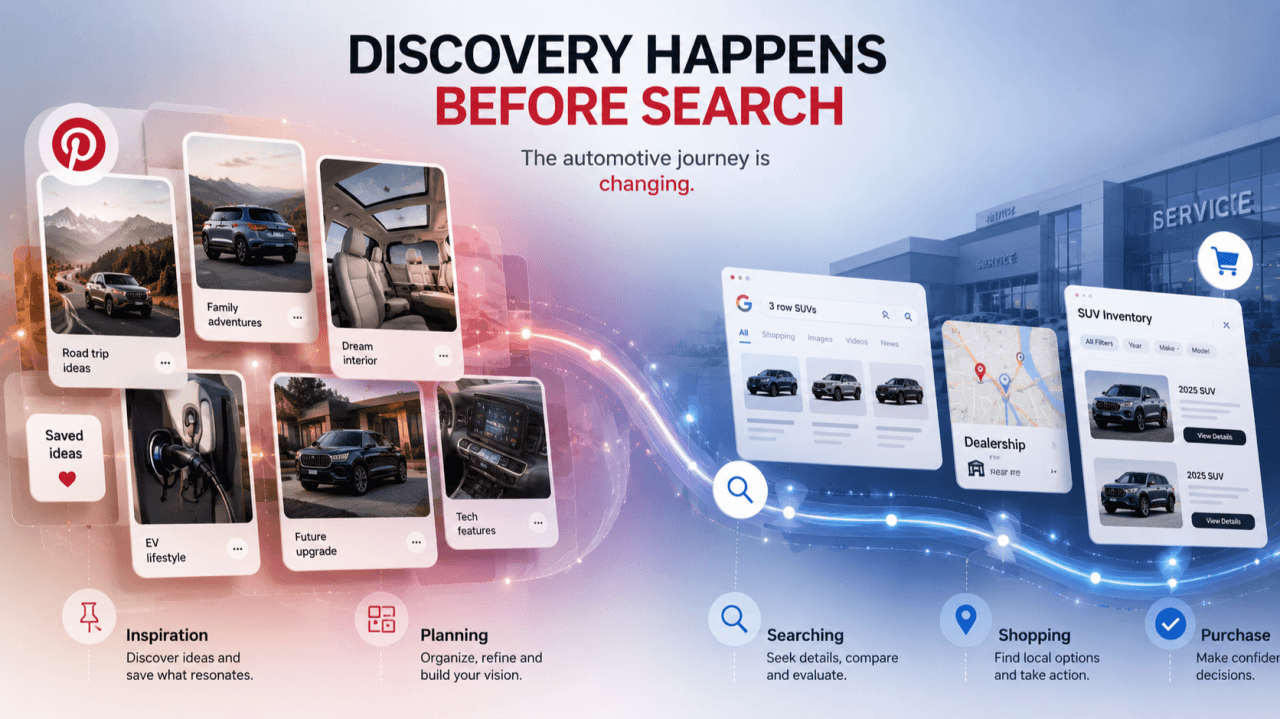
For years, dealership advertising strategies have revolved around traditional search behavior: A shopper realizes they need a vehicle, goes to Google, searches inventory, and dealers compete aggressively at the bottom of the funnel.
But consumer behavior is becoming far more visual and non-linear. People are discovering products before they intentionally search for them.
And that shift has major implications for automotive marketing.
Search Is Changing
According to Pinterest’s 2026 “Reimagine Search” research, the platform now sees roughly 80 billion monthly searches with nearly 50% commercial intent.
That is a massive behavioral shift hiding in plain sight.
Pinterest users are not simply scrolling content. They are actively planning; purchases, lifestyle upgrades, family decisions, future goals, major life moments
Pinterest sits in the space between inspiration and intent. And increasingly, that is where modern shopping behavior starts.
Pinterest research also found that more than half of consumers have used Pinterest as a search engine, while two in three Gen Z shoppers prefer discovering products visually rather than through traditional text-based search.
That should matter to every dealership thinking about the future of customer acquisition.
Because younger consumers are not always beginning with keywords anymore. They are beginning with discovery.
Discovery Happens Earlier Than Dealers Think
The automotive industry still tends to define “intent” too narrowly.
Most dealers focus heavily on the point where shoppers actively search inventory, compare payments, or submit leads. But influence starts much earlier than that.
Someone researching a growing family may begin engaging with SUV content months before they search “best midsize SUV.”
Someone planning a move may start exploring trucks long before they visit a dealership website.
Someone researching EV ownership may begin consuming charging, lifestyle, and technology content before they ever compare models.
Pinterest sits inside that planning phase of the journey.
That matters because automotive purchase decisions are often heavily influenced long before someone enters a lower funnel campaign. Especially among female buyers, who influence the majority of vehicle purchasing decisions in the household.
Pinterest Is Built for Visual Discovery
This is also why Pinterest behaves differently than most traditional social platforms. It is not interruption-based. It is intent-based. Users actively save ideas, organize plans, refine preferences, and revisit content over time. That creates a very different relationship between the consumer and the advertising they see. And for automotive, this opens the door for more than just lower funnel messaging.
Think about all these opportunities to use Pinterest to influence:
- vehicle category consideration
- lifestyle alignment
- technology perception
- design preference
- EV education
- family utility
- luxury positioning
Long before the shopper enters Google search or marketplace sites.
Meanwhile, most dealerships still allocate the majority of spend toward the bottom of the funnel, competing for the same in-market shoppers after intent already exists.
That creates a dangerous dynamic: Everyone is paying to capture demand someone else helped create.
The Dealers Who Adapt Early Win
Pinterest is no longer just an awareness platform.
The platform supports:
- shopping campaigns
- inventory feeds
- video
- retargeting
- conversion campaigns
- offline attribution
- AI-powered optimization
In other words, it is a true full-funnel platform.
The bigger takeaway is this: The future of automotive marketing clearly relies less on capturing searches and more on shaping discovery before the search ever happens.
Because that is where consumer behavior is clearly moving.
The dealerships that recognize that shift early will likely gain a significant advantage over the ones still treating every platform outside of Google and Meta as secondary.
Search is changing.
And dealerships may need to rethink where the buying journey actually begins.