Justin Friend click to view the linkedin profile of : Justin FriendWe’ve spent years trying to simplify the automotive buying journey into something clean.
Awareness. Consideration. Intent. Urgency.
It looks great on a slide. It tends to fall apart in the real world.
The reality is the modern buyer doesn’t move in a straight line. They bounce. They pause. They disappear and come back. They consume content across multiple platforms before ever raising their hand. By the time a lead shows up or a search happens, most of the decision has already been shaped.
A few months back I joined Jason Harris on the Modern Automotive Marketing podcast, and we spent a good amount of time unpacking this exact issue. The biggest takeaway is simple. The industry is still focused on the wrong part of the journey.
The Journey Is Already in Motion Before You See It
Think about how people actually shop today.
A shopper might come across a video while scrolling at night. A few days later, they hear something during a podcast or streaming audio. At some point, they watch a review on YouTube. Maybe they click an ad, maybe they don’t. Eventually, they search a model or a dealership name and convert.
That last step gets all the credit.
But it didn’t do the heavy lifting.
The decision was built slowly, across multiple moments and conversations that most dealerships never measure. Each touchpoint reduces uncertainty. Each interaction builds familiarity. By the time someone takes an action you can track, they are not starting the journey. They are finishing it.
Where Most Strategies Break
The issue is not effort. It’s focus.
Most dealership strategies are still built around the bottom of the funnel. Paid search. Third-party leads. Retargeting. All designed to capture someone who is already in market.
That creates a false sense of performance. Leads come in. Traffic looks stable. Everything feels like it is working.
But nothing is actually growing.
Because you are competing for the same pool of in-market shoppers as every other dealer in your market. You are not expanding demand. You are splitting it.
The Part of the Journey That Actually Decides the Outcome
The real leverage sits earlier than most teams are comfortable operating.
Before someone searches. Before they submit a lead. Before they ever decide which two or three dealerships they are going to consider.
This is where preference is formed.
It’s where a shopper decides which brands feel relevant. Which dealerships feel trustworthy. Which model they feel an emotional connection to. Which options are even worth researching further. And it happens across channels that don’t show up cleanly in a CRM report.
That doesn’t make it less important. It makes it more important.
Because if you are not present in those moments, someone else is shaping the decision for you.
Why Last-Click Thinking Keeps You Stuck
Last-click attribution tells a very clean story. It shows you the final interaction and assigns it full value.
The problem is that it confuses visibility with impact.
Search looks like it drives everything because it is where people show up at the end. Lead providers look efficient because they package intent and hand it to you. Retargeting looks strong because it follows people who already showed interest.
So budgets drift in that direction.
Over time, more and more money goes toward capturing demand. Less and less goes toward creating it. Eventually, performance flattens. Not because the tactics stopped working, but because you are only fishing in the same pond.
What Actually Moves Market Share
The dealers that are gaining ground are not doing anything flashy. They are just playing a different game.
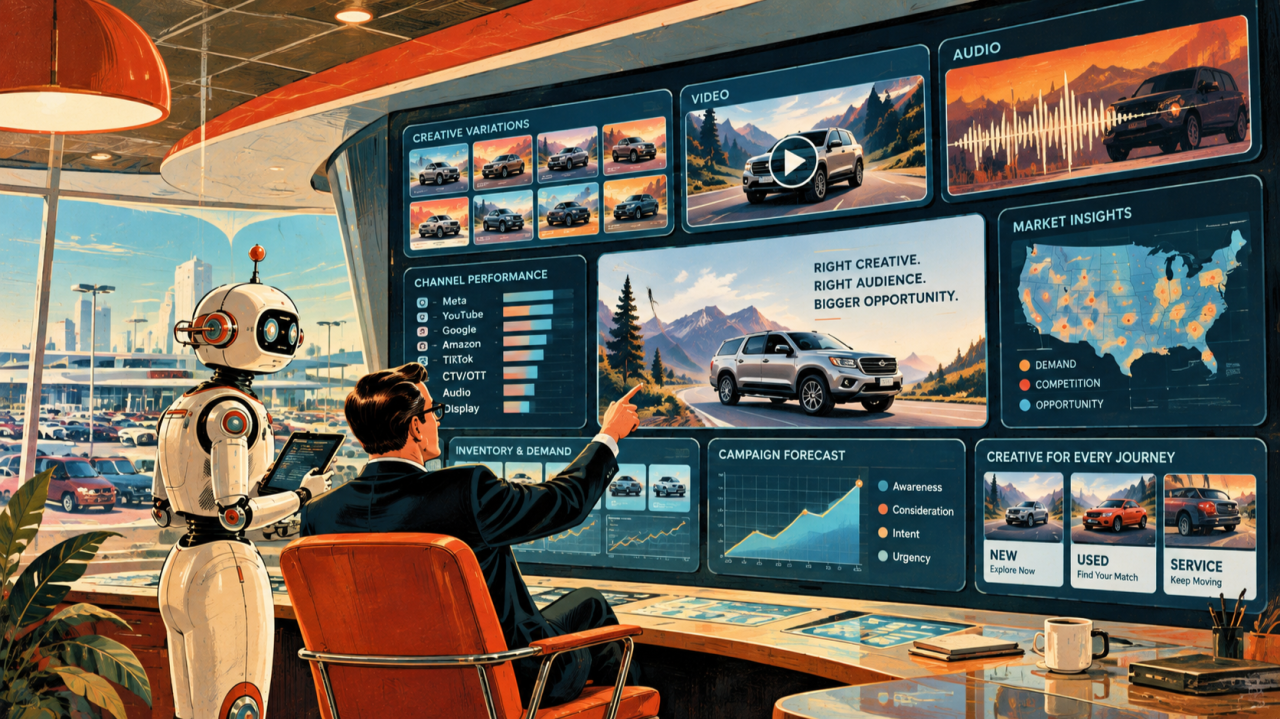
They are showing up earlier. They are staying consistent across channels. They are using creative that matches where the shopper is in their journey, not just pushing offers at the end.
More importantly, they are not relying on a single channel to do all the work.
They understand that influence is cumulative. It builds over time. It requires presence in multiple places, not just dominance in one.
That is what an integrated omnichannel strategy actually looks like in practice. Not more channels for the sake of it, but coordinated pressure across the journey.
Again, a lot of what Jason and I talked about on Episode 1 of Modern Automotive Marketing.
Final Thought
The modern automotive buying journey is not broken. It’s just misunderstood.
This is the question we kept coming back to on the podcast.
If your bottom-of-funnel tactics disappeared tomorrow, what would happen to your demand?
If the honest answer is that not much would change, then your marketing is not creating anything. It is just capturing what was already going to happen.
And if that is the case, growth becomes very hard to build.