The conversation about AI in marketing has become unnecessarily binary. Either AI will revolutionize marketing or it will replace marketers. I believe both views miss the bigger opportunity.
The real opportunity is to give every marketer an AI assistant that removes the operational burden surrounding the work, allowing people to spend more time on the work that actually requires judgment, creativity, strategy, and business understanding.
That distinction matters.
AI can change that equation.
The Productivity Opportunity Is Already Here
AI adoption is no longer theoretical. McKinsey’s 2025 global research found that 71% of organizations regularly use generative AI in at least one business function, with marketing and sales among the functions with the highest adoption rates.
Marketing-specific research points to an even clearer reason for adoption. The 2025 State of Marketing AI report, based on nearly 1,900 marketers and business leaders, found that 82% of marketers identified reducing time spent on repetitive, data-driven tasks as their primary desired outcome from AI. Sixty percent of respondents said their marketing teams were already either piloting or scaling AI.
That tells us something important: marketers aren’t primarily asking AI to replace themselves. They’re asking it to give them back time.
AI Should Remove Work, Not Remove Judgment
Consider what happens when an AI assistant handles the operational layer of a marketing workflow.
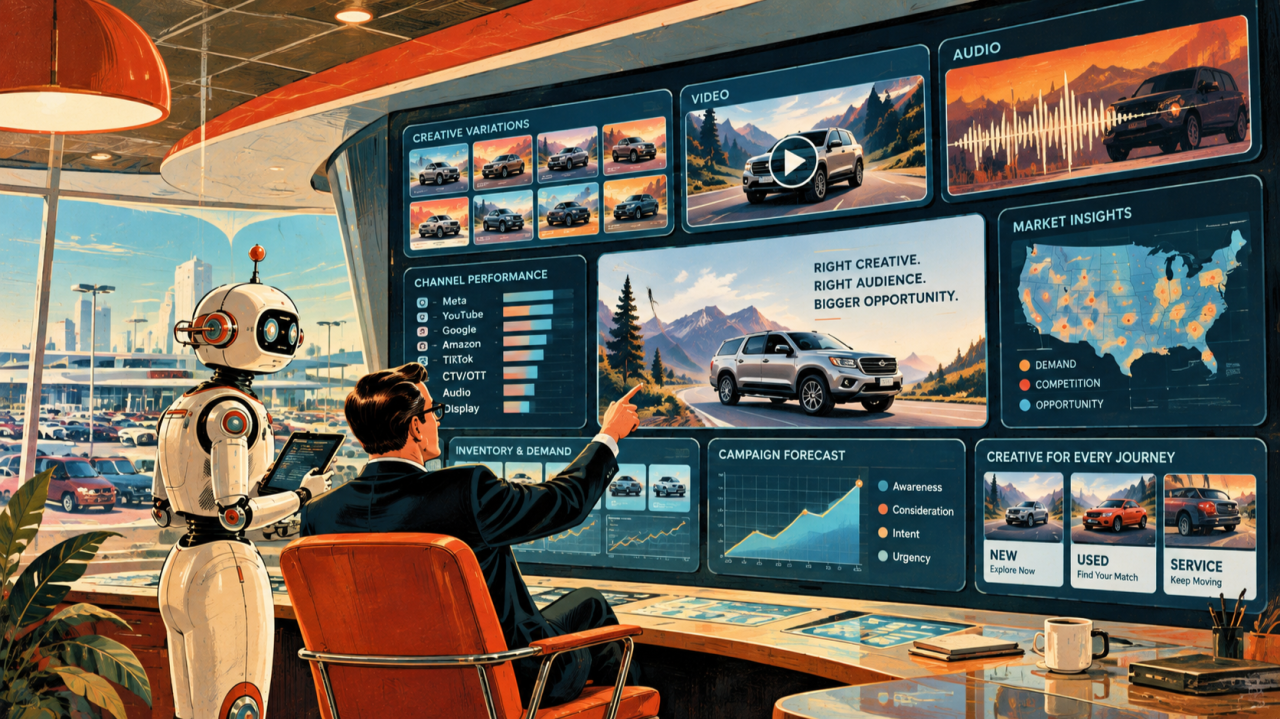
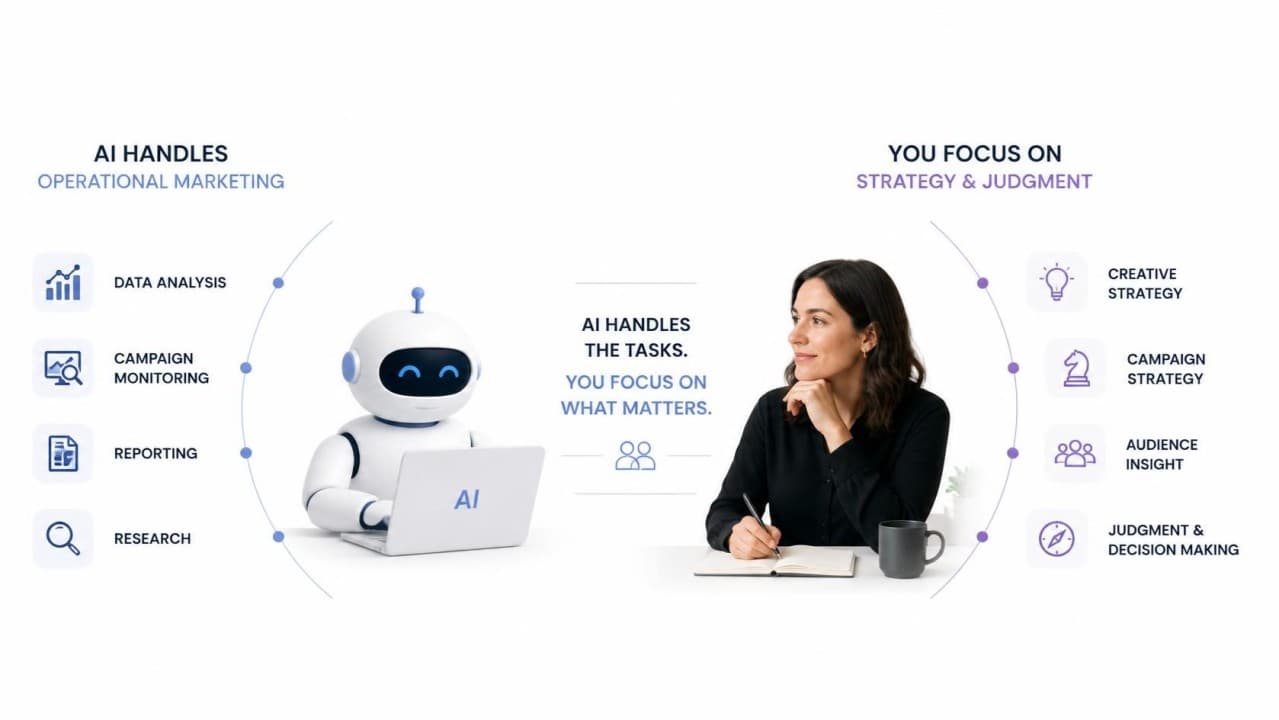
It can monitor campaign performance, summarize anomalies, organize audience data, draft creative variations, identify inventory changes, prepare reporting, research competitors, build initial media recommendations, and surface opportunities that would otherwise require hours of manual analysis.
The marketer remains responsible for deciding what matters, why it matters, and what the business should do about it.
That is the distinction between automation and augmentation.
McKinsey estimates that agentic AI could eventually power roughly 60% of tasks across the marketing process, including content generation, audience testing, media planning, and campaign execution. Its research also estimates that agentic systems could accelerate campaign creation and execution by 10 to 15 times.
Those numbers don’t suggest that marketing departments need 60% fewer people.
They suggest that marketers could potentially accomplish dramatically more with the same people.
The Biggest Risk Is Using AI Too Narrowly
The first generation of marketing AI has largely been used as a collection of productivity tools: write this email, summarize this report, create five headlines, generate an image.
The greater opportunity comes when AI becomes embedded into the workflow itself.
Imagine an AI assistant that knows the dealership’s inventory, historical performance, market conditions, customer segments, media strategy, brand standards, and current promotions. Instead of asking it to write an ad, the marketing team could ask:
Where are we seeing an emerging opportunity, and what should we do about it?
The assistant could identify a demand shift, determine which audiences are affected, recommend where budget should move, develop appropriate creative variations, and prepare the campaign for human approval.
The marketer becomes the strategist and decision-maker rather than the person assembling the pieces.
Human Creativity Becomes More Valuable, Not Less
The more AI handles repetitive execution, the more valuable human creativity and judgment become.
AI can produce 100 versions of an advertisement. It cannot independently determine which strategic idea will change how consumers perceive a dealership or brand.
It can generate a recommendation. An experienced executive needs to determine whether the recommendation aligns with the company’s objectives, economics, brand, and risk tolerance.
This is why the strongest organizations are moving toward human-AI teams, not human-versus-AI teams. McKinsey’s latest research describes the future of work as a partnership between people and intelligent agents, with humans increasingly focused on judgment, relationships, creativity, and higher-value decisions.
LinkedIn and Ipsos found a similar pattern in their 2025 research: marketers who embed AI into strategy, rather than limiting it to execution, reported 13% higher revenue growth and 13% greater cost savings than their peers.
The Competitive Advantage Is What Marketers Do With the Time
The objective should be to eliminate the work that prevents marketers from doing their best work.
If AI can turn a four-hour reporting exercise into a 10-minute review, the win isn’t the three hours and 50 minutes saved. The win is what the marketer does with those hours: better planning, sharper creative, deeper customer understanding, faster decisions, and more time focused on growth.
That’s the real AI opportunity.
AI shouldn’t replace the marketer. It should make the marketer more capable.
The organizations that understand that distinction will not simply use AI to reduce costs. They’ll use it to increase the speed, intelligence, and strategic capacity of their marketing teams.
And that is a much bigger competitive advantage.