
An OEM announces its new incentives on the 2nd of the month.
There is a compelling lease offer on a high-volume model. Maybe there is bonus cash on another vehicle the dealer has plenty of sitting on the ground. At that moment, every dealer has access to essentially the same opportunity. The difference is how quickly they can act on it.
For many dealerships, that’s where the clock starts ticking. New creative needs to be built, offers need to be incorporated across different formats and campaigns need to be updated across channels. What sounds like a relatively simple change can turn into days of production and deployment.
By the time the new advertising is actually running, it is the 14th.
Nearly half the month is gone.
That process has been accepted as normal in automotive advertising for a long time. It shouldn’t be anymore.
Speed to market is becoming a competitive advantage.
The Cost of Being Late
Most dealerships operate in highly competitive markets, selling the same vehicles, promoting the same OEM incentives and competing for the same consumers. The advantage isn’t always having something your competitors don’t. Sometimes it’s simply getting there first.
Every day a new incentive isn’t in market is a missed opportunity. And this isn’t just about updating a paid search ad. Consumers move across search, social, streaming video, Connected TV, audio and other digital channels. If an offer matters, it should be reflected across that experience.
That’s where traditional production slows things down. A still image is one thing. Building video, audio and channel-specific creative takes longer. By the time everything is produced and deployed, a meaningful portion of the offer window may already be gone.
The campaign may eventually be right.
It was just late.
From Production Cycle to Same-Day Opportunity
This is where automation, data and AI can fundamentally change the process.
OEM incentives can be ingested as they become available. Dealer-specific offers can be incorporated alongside them. Inventory data can identify which models are actually in stock and worth supporting.
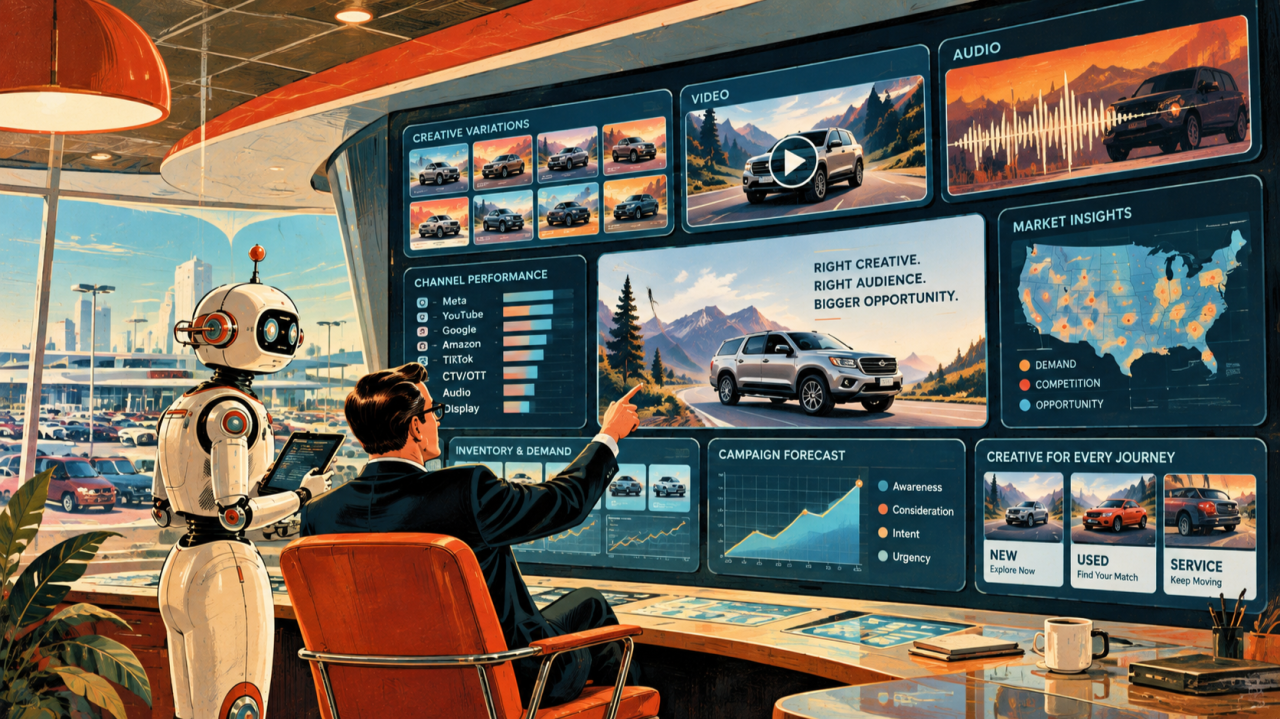
From there, automated creative production can turn those inputs into the formats required across channels, including still images, video and audio.
What used to be a production cycle can become a deployment cycle.
The target should increasingly be same-day speed to market.
That doesn’t mean removing people from the process or blindly publishing every offer that appears in a data feed. Dealers still need control over their strategy, messaging and what they choose to promote.
It means eliminating the unnecessary time between deciding an offer matters and actually putting it in front of consumers.
Automation isn’t valuable because it eliminates work. It’s valuable because it eliminates delay.
Speed Changes More Than Efficiency
There is an obvious operational benefit. Less manual production means fewer handoffs and less time rebuilding creative every time something changes. But efficiency isn’t the real prize.
Speed creates more opportunity to win.
If a compelling offer drops today, getting it into market today means more time for consumers to see it, engage with it and act on it. And when that messaging is specific to the models actually sitting on the lot, the advertising becomes more relevant at the same time it becomes more timely.
It also changes how a dealership can operate throughout the month. Inventory shifts. A model needs more support. The dealer introduces an aggressive offer. An OEM incentive suddenly makes a vehicle much more compelling.
Those are opportunities to act, not requests to put into next week’s production queue.
At Proficy, that’s why we’ve invested so heavily in connecting data, automation and AI directly to creative production. The goal isn’t to make more ads. It’s to collapse the time between seeing an opportunity and attacking it in market, across still, video and audio and across the channels where consumers are spending their time.
Because being first matters. Every additional day in market is another day to capture attention, influence a shopper and create an opportunity before the dealer down the street does.
More creative isn’t the advantage. More relevant creative, deployed faster, is.
The Advantage Compounds
Imagine two dealerships competing in the same market.
They sell the same brand. They receive the same OEM incentive. They have comparable inventory and similar advertising budgets.
One has updated still, video and audio creative in market almost immediately. The other gets there 10 or 12 days later.
I’ve always thought about advertising a little like fishing. If we’re all fishing for the same fish in the same water, but I can get better bait on all of my lines before everyone else, I like my chances of eating fish for dinner.
And that advantage compounds.
At 10 days a month, that’s 120 days a year. At 12, it’s 144 days.
Think about that. What could your dealership do with four additional months every year of having the right offers in front of consumers while your competitors are still trying to get theirs into market?
More opportunities to earn attention. More opportunities to create engagement. More opportunities to influence the shopper before someone else does.
That’s not just speed.
That’s a competitive advantage.