David Raminick click to view the linkedin profile of : David Raminick
Why Omnichannel Advertising Requires Omnicreative
Automotive advertising has entered a new era, but much of the industry is still using an old playbook.
For decades, success was built around creating one compelling television commercial, one monthly offer, and distributing that message as broadly as possible. Today’s consumer journey makes that approach increasingly ineffective. Buyers no longer move through a linear sales funnel, and they don’t consume media through a single channel. They discover vehicles through search, social media, streaming video, Connected TV, podcasts, websites, email, and dealership visits, often moving between those touchpoints dozens of times before making a purchase.
The expectation has changed. Consumers no longer expect to see the same message everywhere. They expect every interaction to be relevant to where they are on their buying journey.
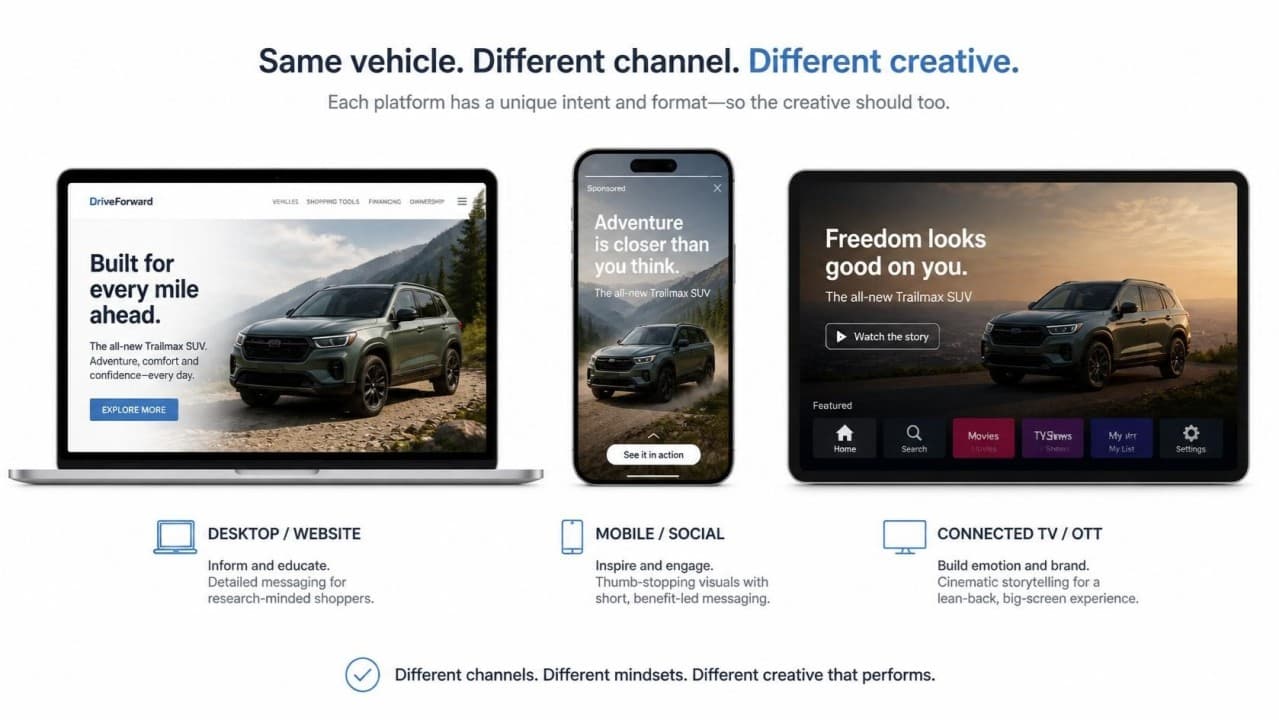
Research from Google has shown that shoppers move unpredictably between channels, using each platform for a different purpose. Someone watching a YouTube vehicle review is looking for education. A shopper searching for “best lease deals near me” is looking for immediate action. A Facebook user may simply be discovering a vehicle they hadn’t previously considered. Delivering identical creative across each of those environments ignores the context in which consumers engage.
That context matters because relevance consistently outperforms repetition.
McKinsey has found that companies leading in personalization generate 40% more revenue from those efforts than their competitors, while the vast majority of consumers say they are more likely to purchase from brands that provide relevant experiences. Likewise, Google and Meta continue to emphasize that creative quality has become one of the largest drivers of advertising performance, often having a greater impact than audience targeting alone. Better targeting may determine who sees your message, but better creative determines whether that message is remembered.
For automotive retailers, personalization extends well beyond inserting a shopper’s name into an email. Every vehicle category represents a different purchase decision. EV shoppers care about charging, range, and incentives. Truck buyers evaluate capability and towing. Luxury buyers are influenced by craftsmanship, technology, and ownership experience. Service customers value convenience, trust, and transparency. Treating these audiences with the same monthly sales message creates generic advertising that resonates with very few shoppers.
The same principle applies across the buying journey. First-time visitors need inspiration and education. Returning shoppers need inventory updates, payment options, or reasons to act. Customers approaching lease maturity require entirely different messaging than owners simply researching future possibilities. Modern advertising platforms can now adapt creative dynamically based on audience behavior, CRM data, vehicle availability, market conditions, and predictive buying signals. Technology exists to make every impression more relevant than the last.
Perhaps the biggest opportunity for dealerships, however, is something national advertisers simply cannot replicate: hyper-local creative.
Automotive retail has always been local, yet much of today’s advertising still feels generic. Consumers respond to familiarity. They want to see the roads they drive every day, the neighborhoods they recognize, local landmarks, regional events, seasonal weather, and inventory that actually exists on the dealer’s lot. A truck campaign in rural Texas should not look or sound like one running in downtown Chicago. An EV campaign in Southern California should differ dramatically from one in northern Michigan during the winter. Local relevance builds authenticity, trust, and credibility in ways that templated creative never can.
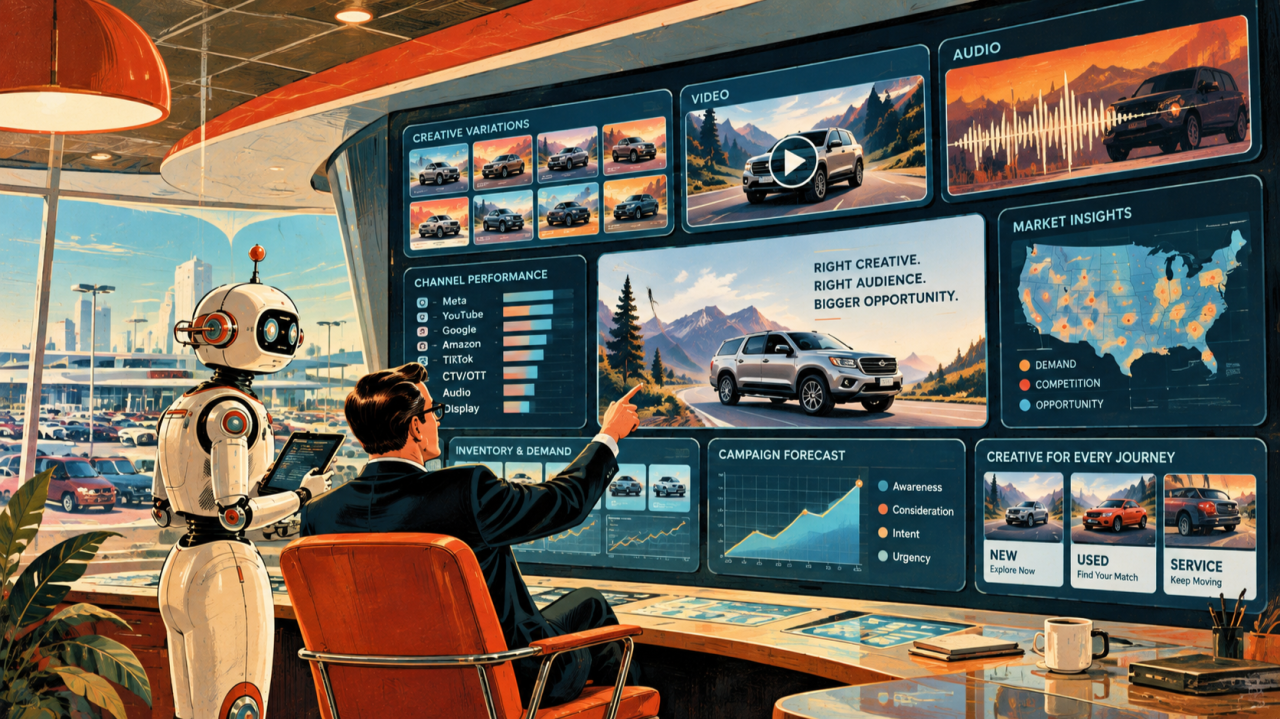
This is where artificial intelligence is beginning to reshape automotive marketing. Dealers can now produce localized creative at scale, generating versions tailored to specific markets, audiences, inventory levels, weather conditions, incentives, and media channels without sacrificing brand consistency. Instead of one campaign serving every shopper, a dealership can deploy hundreds of creative variations, each designed to match a specific consumer context.
The business case for this approach is compelling. Google has reported that advertisers using responsive and dynamically optimized creative often achieve meaningful improvements in conversions because messaging better aligns with consumer intent. Dynamic Creative Optimization (DCO) studies from multiple ad technology providers have also demonstrated higher click-through rates and stronger engagement when creative adapts to audience signals rather than relying on static assets.
This represents a fundamental shift in how competitive advantage is created. For years, marketers focused primarily on buying better media. Increasingly, the differentiator is not where you advertise, but what consumers see when they get there.
The dealerships that will lead over the next decade won’t necessarily have the largest advertising budgets. They’ll have the most adaptable creative strategy. They’ll understand that omnichannel advertising requires omnichannel creative, where every message reflects the channel, the vehicle, the shopper’s intent, and the local market.
In today’s automotive landscape, creative is no longer just the packaging around an advertising campaign.
It is one of the most important drivers of its performance.